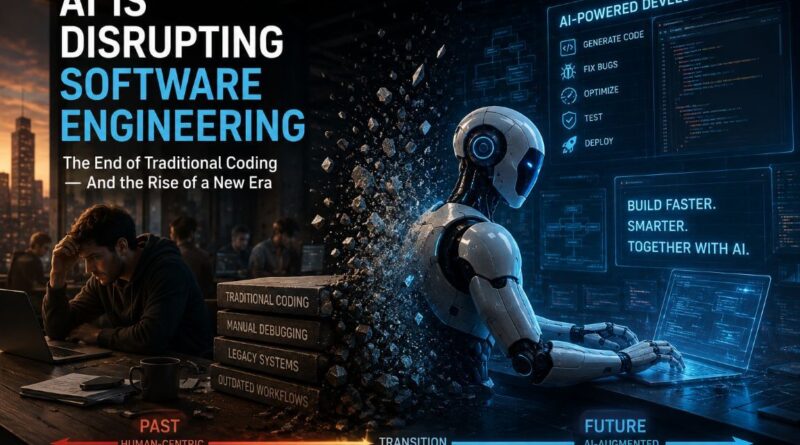
The Great Code Shift: How Autonomous Agents Are Unleashing Unprecedented AI Software Engineering Disruption
AI software engineering disruption has reached a transformative inflection point, reshaping the foundational economics of the global technology sector as autonomous agents handle the vast majority of routine coding and bug remediation. While individual software engineers report massive personal productivity gains when paired with state-of-the-art reasoning models, software organisations face an unexpected paradox: rapid feature development is expanding engineering backlogs rather than shrinking them, while unleashing a wave of unvetted AI “slop” and structural technical debt. At the same time, a sharp contraction in entry-level hiring threatens to sever the industry’s talent pipeline. This comprehensive investigation examines the economic mechanisms, architectural risks, and human workplace shifts defining software development in the agentic era.
The 10x Productivity Illusion and Jevons Paradox
Across modern engineering organisations, software developers using agentic coding environments report completing tasks in hours that previously required weeks. Developers frequently describe orchestrating multiple autonomous AI agents simultaneously, stepping away from manually typing syntax to focus on high-level architecture and system design. Yet, counterintuitively, this massive boost in personal efficiency has rarely resulted in developer downtime or shrinking engineering departments.
Instead, the software sector is experiencing a classic manifestation of Jevons Paradox—an economic phenomenon where increasing the efficiency of a resource lowers its cost, driving total consumption of that resource sky-high. In software engineering, as the cost of producing line-by-line code approaches zero, corporate demand for new features, experimental minimum viable products (MVPs), and bespoke internal tools expands exponentially.
“Every project used to start with a whiteboard session where you’d write 100 ideas and immediately cross out 95 due to limited developer bandwidth. Now that everyone is five times more productive, you only cross out 75. The hunger for custom software features is virtually bottomless.”
According to the PwC 2026 AI Jobs Barometer, companies leading in AI technology exposure have achieved a dramatic 163% increase in workforce productivity growth compared to non-exposed peers. Rather than using these gains strictly for cost reduction, forward-thinking enterprises are using elevated output capacity to unlock new markets, deploy hyper-personalised customer tools, and execute ambitious software roadmaps that were previously financially non-viable.
The Dark Side of Vibe Coding: 10x Tech Debt and AI Slop
Despite headline-grabbing efficiency gains, veteran engineering leads warn of a dangerous counter-trend: the rapid accumulation of unmaintainable, AI-generated “slop.” While large language models excel at producing syntactically correct code snippets, they operate much like hyper-fast, overly confident junior developers. Without rigorous human oversight, agentic workflows frequently introduce subtle architectural anti-patterns, hallucinated dependencies, and shortcut solutions that break down under real-world production loads.
When non-technical employees or inexperienced engineers rely exclusively on natural language prompting—a practice popularised as vibe coding—they frequently bypass foundational engineering practices like unit testing, modular boundary isolation, and edge-case validation. Senior software architects now report spending an increasing proportion of their workweeks auditing, refactoring, and fixing code produced by autonomous agents.
| Dimension | Traditional Software Engineering | Agentic AI Era Engineering |
|---|---|---|
| Primary Bottleneck | Syntax implementation and manual bug fixing | System design, code auditing, and requirement specification |
| Code Velocity | Incremental, human-bounded line output | Exponential, token-bounded batch generation |
| Technical Debt Risk | Human oversight errors, rushed deadlines | Unvetted AI “slop,” hallucinated logic, hidden edge-case flaws |
| Core Competency | Language syntax, algorithmic design | Intent engineering, architectural boundaries, system debugging |
| Junior Role Focus | Writing boilerplate code, fixing minor bugs | AI output verification, test harness creation, prompt refinement |
The economic cost of managing AI-generated complexity is rising fast. When developers accept agentic pull requests without deep line-by-line reviews, hidden vulnerabilities compound across codebases, leading to unexpected system failures and skyrocketing maintenance overhead.
The Abstraction Ladder: Navigating the Library of Babel
Historically, the evolution of software development has been defined by moving up the abstraction ladder—from assembly language and machine code to high-level languages like C, Java, and Python, and eventually to cloud infrastructure platforms. The current wave of AI software engineering disruption represents another upward step, elevating developers from code authors to system directors and AI operators.
Writing code was always the most mechanical part of the software engineering discipline. The true core of software engineering lies in domain modelling, trade-off analysis, user empathy, and defining precise boundaries for complex systems. Modern AI reasoning models function much like Jorge Luis Borges’s mythical Library of Babel—they contain every possible permutation of code but lack the contextual awareness to determine which specific solution safely solves a human business problem.
As demonstrated in the operational model above, when AI generation speed outpaces human review bandwidth, technical debt grows at an exponential rate. To keep codebases healthy, engineering teams must maintain strict architectural guardrails and automated testing harnesses.
The Junior Developer Vacuum and AI Software Engineering Disruption
While senior engineers with deep architectural knowledge leverage AI agents as force multipliers, early-career software developers face an increasingly difficult job market. Traditionally, junior developers honed their skills by writing routine boilerplate, refactoring simple modules, and fixing low-priority bugs—the exact tasks now automated by agentic AI tools.
Data from the Stanford Digital Economy Study reveals that between late 2022 and mid-2025, employment for software developers aged 22 to 25 fell by nearly 20%. As tech companies squeeze entry-level headcount to optimise short-term margins, industry experts raise concerns about a long-term talent drought.
“It takes 10 to 15 years to mentor a junior engineer into a senior software architect. If companies eliminate entry-level positions today, who will lead enterprise system design in 2035?”
Research from the PwC AI Jobs Barometer highlights that surviving entry-level job postings are undergoing severe “seniorization.” Modern junior roles are 7 times more likely to demand high-level decision-making, architectural planning, and leadership skills than comparable entry-level positions prior to the AI boom.
Shadow IT Chaos: Enterprise Vibe Coders Run Amok
The democratizing power of generative AI has encouraged non-technical employees—ranging from marketing managers to financial analysts—to build custom internal software applications using natural language prompts. While these “vibe coders” streamline local department workflows, they present major operational challenges for enterprise IT and security teams.
Information technology departments report a surge in unmonitored shadow applications running across enterprise networks. Common security vulnerabilities identified in non-engineer vibe-coded applications include:
- Unencrypted customer data tables stored on public cloud buckets
- Complete absence of enterprise Single Sign-On (SSO) authentication
- Hardcoded API keys and sensitive credentials exposed in source repositories
- Lack of disaster recovery protocols or backup routines
- Non-compliance with regional data privacy frameworks like GDPR and CCPA
When these rogue applications fail or suffer data breaches, centralised IT teams are forced to divert critical resources to restore systems and secure enterprise data.
Token Economics, Model Subsidies, and Market Realities
The long-term economic trajectory of agentic software development remains tied to the underlying economics of AI compute infrastructure. Current model usage is heavily subsidised by cloud providers and venture capital funding, making high-volume agentic iteration deceptively cheap for enterprise adopters.
According to the Deloitte 2026 Global Software Industry Outlook, as hardware costs, power demands, and token consumption scale, enterprise application pricing and inference unit economics will come under increased scrutiny. Gartner projects that 40% of enterprise applications will feature task-specific AI agents by the end of 2026, up from less than 5% in 2024. However, if model subsidies recede and token pricing escalates, companies may discover that running autonomous agent loops indefinitely for complex software tasks approaches or exceeds the cost of human engineering hours.
In summary, autonomous agents are not eliminating the software engineering profession; rather, they are fundamentally redefining what it means to build software. Developers who evolve into AI system orchestrators, domain architects, and intent strategists are achieving unprecedented levels of creative leverage, while engineering leaders must grapple with junior talent preservation, rigorous code verification, and security governance.
Will the technology industry successfully reinvent its talent pipelines to train the next generation of senior software architects, or will AI-generated complexity eventually outpace human capacity to maintain it?
Cross-Platform Developer Sentiment Matrix
| Platform | Source / Author | Perspective & Comment Summary | Sector Alignment |
|---|---|---|---|
| Hacker News | @sw_arch_99 | “AI writes code instantly, but debugging subtle race conditions in agentic PRs takes three times longer than writing the code by hand. We are swapping typing time for reading time.” | Tech Debt Sceptic |
| David Chen, VP of Engineering | “The career path for junior engineers is changing overnight. We aren’t hiring coders anymore; we are hiring system designers who know how to command AI tools effectively from day one.” | Shift to Architecture | |
| Twitter / X | @vibe_coder_dev | “Built and launched a full SaaS product over the weekend using agentic workflows. No traditional computer science degree, just clear prompt intent and API wiring. The barrier to entry is gone.” | AI Democratization |
| Substack | The Software Pragmatist | “Jevons Paradox ensures software engineers aren’t going anywhere. Lowering code costs simply means every business will demand custom software tailored to every single micro-process.” | Economic Optimist |
| YouTube | TechLead Insights | “Beware of the 10x productivity illusion. If you generate 10x the code without automated test harnesses, you are simply generating 10x the production incidents.” | Risk Warning |
| Medium | Sarah Jenkins, Lead Architect | “We let a vibe-coded internal dashboard slip into production. It worked great until it exposed unencrypted customer records because no one implemented SSO or RBAC.” | Security & Governance |
| Enterprise Devs Group | “Token costs are going to bite companies in the end. Running agentic loops for 3 hours to refactor a legacy codebase costs real compute money that rivals offshore engineering.” | Token Economics | |
@code_and_coffee | “My daily routine changed completely. I spend 20% of my day prompting agents and 80% reviewing code outputs, writing documentation, and meeting with product leads.” | Workflow Evolution |