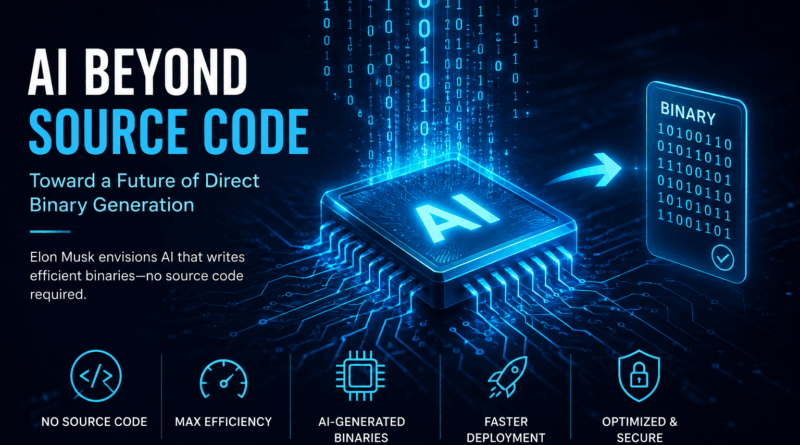
Elon Musk’s Revolutionary Vision for AI Direct Binary Generation Sparks Global Tech Debate
When Elon Musk declared that artificial intelligence will soon bypass traditional human programming languages entirely, he ignited a fierce debate across the global software development ecosystem. The concept of AI Direct Binary Generation, where neural networks emit raw, optimised machine code directly from high-level natural language intent, promises to eliminate human-readable source code in favour of pure machine execution. Tech visionaries hail this transition as the logical next leap beyond traditional compilers, drawing parallels to how high-level languages like C and Python rendered assembly code niche decades ago. However, systems architects, cybersecurity experts, and veteran software engineers warn that stripping away human-readable code creates severe risks around auditability, cross-platform portability, and deterministic safety.
The Bold Claim: Bypassing High-Level Code
The ongoing debate began when investor James Douma reflected on the history of computing on social media, noting that nearly half a century ago, programmers stopped writing assembly language because they learned to trust compiler technology to generate binary instructions accurately. Elon Musk endorsed this viewpoint, asserting that source code itself is on the verge of becoming an obsolete intermediate layer.
“This is exactly right. Source code is on the verge of becoming like assembly. The next step is getting rid of ‘source code’ entirely and just making an efficient binary directly with AI.” — Elon Musk
In Musk’s vision, software workflows will collapse from the multi-stage pipeline of human intent → source code → compiler → machine binary down to a direct bridge: natural language prompt → AI Direct Binary Generation → execution. Proponents argue that neural networks trained directly on machine instructions can discover novel hardware optimisations that traditional rule-based compilers miss, maximising execution speed and hardware efficiency.
Compilers vs. AI Direct Binary Generation
To evaluate whether machine-learning models can effectively replace high-level programming languages, we must compare traditional compilation against the proposed neural binary synthesis paradigm. Traditional software development relies on deterministic translation layers, whereas AI Direct Binary Generation introduces probabilistic inference directly at the machine instruction level.
| Dimension | Traditional Compiler Pipeline | AI Direct Binary Generation |
|---|---|---|
| Primary Input | Human-readable source code (C++, Rust, Python) | Natural language prompts / Specification constraints |
| Translation Nature | Deterministic & mathematical | Probabilistic & stochastic |
| Human Auditability | High (Code reviews, Git diffs, static analysis) | Extremely Low (Opaque machine opcodes) |
| Target Portability | Universal (Single source compiles to x86, ARM, RISC-V) | Hardware-Locked (Must re-generate separate binaries per chip) |
| Debugging & Verification | Line-by-line step debugging & stack traces | Black-box disassembly & statistical verification |
| Optimization Method | Formal transformations (e.g., LLVM optimisation passes) | Pattern matching over neural training distributions |
The fundamental distinction lies in predictability. When a C++ or Rust compiler compiles code, every build yields identical machine instructions for identical inputs. Conversely, neural networks remain inherently non-deterministic unless strictly constrained with fixed random seeds and rigid sampling bounds.
The Technical Reality: Why Systems Architects Are Sceptical
While skipping human code sounds enticing on paper, senior systems engineers point out severe engineering bottlenecks that arise when removing intermediate source abstractions.
- The Loss of Human Auditability: Source code isn’t just an instruction manual for microprocessors; it is the primary medium for human collaboration, peer review, and regulatory auditing. Stripping away source code turns every executable into a black box, making security checks for zero-day vulnerabilities or backdoors extraordinarily difficult.
- Cross-Platform Portability Fragmentation: A single repository written in C or Go can be compiled to run on desktop x86 processors, mobile ARM chips, or embedded RISC-V microcontrollers. Direct machine-code synthesis requires the AI model to re-synthesise and test entirely distinct binary blobs for every target microarchitecture.
- Debugging Nightmares: When software crashes due to a memory corruption bug, developers rely on stack traces and human-readable variable names. In a pure AI Direct Binary Generation model, a crash leaves engineers staring at raw hex dumps and CPU registers without contextual metadata.
- Version Control Incompatibility: Modern engineering relies on version control tools like Git to compare changes line by line. Binary executable blobs cannot be meaningfully “diffed,” breaking fundamental continuous integration and continuous deployment (CI/CD) pipelines.
Computer scientists also highlight the theoretical boundary described by Kolmogorov complexity. As natural language prompts are refined to eliminate ambiguity and specify exact edge-case behaviour, those prompts inherently expand in complexity until they resemble a formal programming language themselves.
Industry Dynamics and the Shift Toward AI-Native Workflows
Despite technical scepticism regarding pure binary generation, the broader tech landscape is undeniably shifting toward AI-generated software. Recent industry reports on AI-generated software reveal that leading AI labs like Anthropic now have over 80% of their routine internal codebase generated or assisted by AI models.
- Exponential Velocity Gains: Daily merged code volume per engineer has surged nearly eightfold over two years as developers transition into code reviewers.
- Expanding Task Horizons: Autonomous coding agents can now operate continuously across 12-hour task horizons without losing context window coherence.
- Evolving Enterprise Toolchains: Major platforms are embedding deep repository management directly into conversational interfaces, streamlining end-to-end feature delivery.
Rather than jumping directly to raw machine binaries, these industrial workflows maintain high-level source code as the durable, inspectable artifact while letting AI handle the heavy lifting of code authoring and refactoring.
The Future Role of Software Engineers
Does the rise of AI Direct Binary Generation mark the end of the traditional software developer? Most industry analysts view this transition not as an extinction event, but as an elevation of abstraction layers.
When assembly gave way to high-level compilers, software engineering didn’t disappear; it exploded in scope because developers could build far more complex applications in less time. If future AI models manage to generate compiled binaries safely for specific specialised domains, the human developer’s role will shift toward system design, formal specifications, security verification, and high-level architecture.
Reader Debate: Global Perspectives on AI Direct Binary Generation
The tech community across major digital platforms remains sharply divided on whether eliminating source code is a visionary breakthrough or a dangerous engineering misstep.
| Platform | Commenter / Source | Perspective & Verbatim Quote |
|---|---|---|
| Substack | Adam Holter (Engineering Deep Dive) | “Compilers already convert code to binary deterministically in milliseconds. Having an LLM approximate what gcc -O3 does is just adding stochastic error to a solved problem.” |
| Twitter / X | Elon Musk (@elonmusk) | “This is exactly right. Source code is on the verge of becoming like assembly. The next step is getting rid of ‘source code’ entirely and just making an efficient binary directly with AI.” |
| Technical Career Analysis (Cloud Soft Solutions) | “The paradigm is shifting from writing lines of code to directing AI systems toward outcomes. Developers will evolve into prompt engineers, system architects, and outcome validators.” | |
| Hacker News | Systems Architect (piokoch) | “If you want a specification that describes precisely what software is doing, you need to write it clearly. If your prompts become the durable artifact, then English effectively becomes your source code.” |
| Medium | Tech Writer (Zijian Huang) | “A binary compiled for x86 won’t run on ARM or RISC-V. Source code abstracts target hardware for free. Direct binary output forces the AI to regenerate software N times for N target architectures.” |
| YouTube | Valuetainment Debate (Tech Forum) | “Removing source code removes the only human-readable layer. In a world where neural networks hallucinate, auditing a raw binary blob for edge cases is practically impossible.” |
Developer Community (Software Guild) | “Without source code, version control systems like Git break down completely. You cannot diff two binary blobs line-by-line during a critical production crash.” | |
Tech Commentator (@TechInnovatorsDaily) | “Building full applications directly from simple prompts without wrestling with compilation errors is the ultimate democratization of technology for non-technical creators!” |
As artificial intelligence continues to reshape how software is built, the tech industry stands at a critical crossroads between rapid AI-driven automation and traditional engineering rigors. While AI Direct Binary Generation may find niche application in specialised micro-optimisations, human-readable source code remains the vital bridge between human logic and machine execution.
Will human programmers ever fully trust a black-box AI binary without seeing the underlying source code?